Blockchain basics · 3 min read
Mining and Validators: Who Actually Keeps a Blockchain Running
Blockchains have no central operator, yet new blocks appear every few seconds or minutes. How proof of work and proof of stake decide who adds them, and why it matters to users.
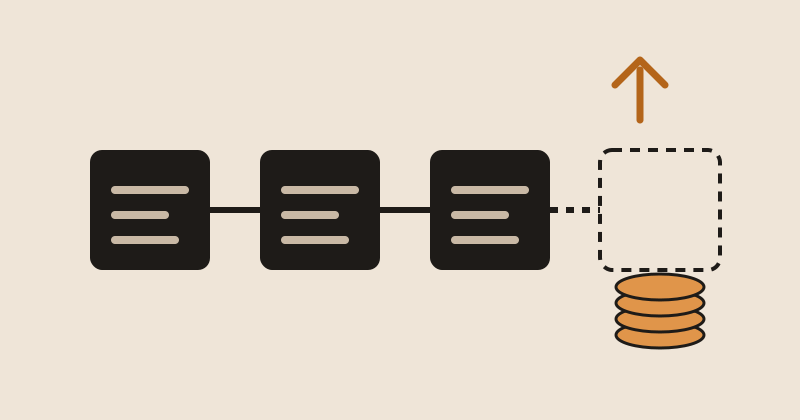
A blockchain is often described as a ledger with no owner. Someone still has to do the work of collecting transactions, packaging them into blocks and agreeing on which version of the ledger is the real one. On most public networks that job falls to miners or validators, and the rules that govern them are called a consensus mechanism.
The problem consensus solves
Thousands of computers around the world keep copies of the ledger, and they cannot simply trust one another. Some may be offline, some may have outdated information and some may be actively trying to cheat. Computer scientists call this the Byzantine generals problem: how can many parties agree on one version of events when some of them may be unreliable?
Public blockchains solve it by making it expensive to propose blocks and rewarding those who follow the rules. The two main approaches differ in what that expense is.
Proof of work
In proof of work, used by Bitcoin, miners compete to solve a mathematical puzzle. The puzzle has no shortcut: the only way to find a solution is to try enormous numbers of guesses, which consumes electricity and specialised hardware. The first miner to find a valid solution adds the next block and collects a reward, made up of newly created coins and the fees paid by the transactions in the block.
Because finding solutions is costly, rewriting history would require an attacker to redo all that work faster than the rest of the network combined. That is what makes older blocks secure. The cost is energy consumption, which has made proof of work the subject of long debates.
Individual miners rarely find blocks alone, since the odds are tiny. Most join mining pools, which combine the computing power of many participants and share the rewards in proportion to the work each contributes. Pools make income steadier for miners. They also concentrate influence, and the share of the network controlled by the largest pools is watched closely.
Proof of stake
In proof of stake, used by Ethereum since 2022, there is no puzzle. Validators lock up some of the network's own currency as a deposit. The protocol selects validators to propose and confirm blocks, and rewards them for doing so correctly. If a validator breaks the rules, for example by signing two conflicting blocks, part of its deposit can be destroyed, a penalty known as slashing.
The security comes from that deposit: attacking the network would require controlling a large share of the total amount locked, and an attacker would risk losing it. Proof of stake uses far less energy than proof of work. Critics point out that it can favour those who already hold large amounts. The ethereum.org explanation of proof of stake covers the mechanics in detail.
Why this matters to ordinary users
The consensus mechanism determines how quickly transactions become final. On proof of work networks, finality is probabilistic and grows with each new block, which is why exchanges wait for several confirmations. Many proof of stake networks reach a point of explicit finality after which a block cannot be reversed without destroying large deposits.
It also shapes fees and decentralisation. When block space is scarce, fees rise. When a handful of pools or validators control a large share of block production, they gain the theoretical ability to censor or reorder transactions, which matters for anyone who values a neutral network.
Finally, it affects privacy in a subtle way. Miners and validators see transactions before they are confirmed and decide which to include. On public networks this is visible to everyone, and it is one more reason why the ledger should be treated as an open book, as we explain in our guide to how block explorers work.
A system of incentives
Behind the technical vocabulary, both mechanisms rely on the same idea: make cheating expensive, make honesty profitable and let anyone check the result. Understanding who keeps a blockchain running, and what they are paid to do, is a good foundation for judging any network you choose to trust with your money.