Security · 3 min read
Phishing, Fake Apps and Address Poisoning: How Crypto Scams Work
Most crypto theft relies on deception. The tactics scammers use most often, from look-alike websites to poisoned transaction histories, and how to recognise them.
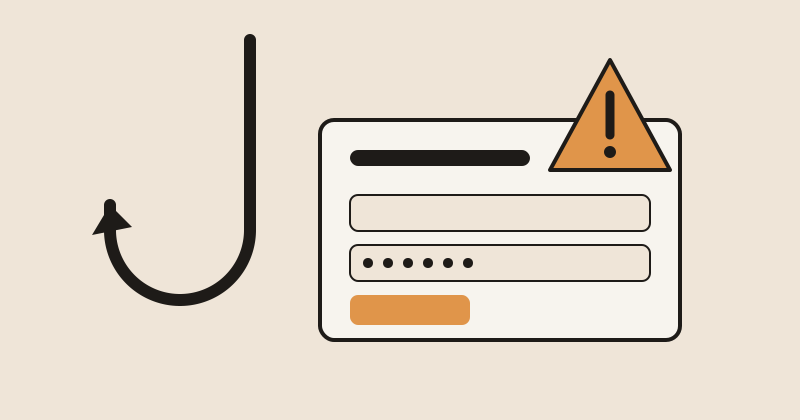
When people imagine crypto theft, they picture skilled hackers breaking cryptography. In reality, the cryptography almost never breaks. Most losses happen because someone is persuaded to hand over a key, approve a malicious transaction or send funds to the wrong address. Scammers exploit habits and emotions, and the defence starts with recognising their patterns.
Phishing
Phishing means impersonating a trusted service to steal credentials. In crypto it usually takes the form of an email, text message or social media post claiming that your wallet or exchange account has a problem. The message links to a convincing copy of the real website, often on a domain that differs by a single letter, a technique known as typosquatting.
The copied site then asks for your login, your two-factor code or, worst of all, your recovery phrase. Paid search adverts are a common route: a fake site can appear above the real one in search results. Bookmarking the sites you use and reaching them only through those bookmarks removes most of this risk.
Fake apps and browser extensions
Counterfeit wallet apps occasionally appear in app stores and as browser extensions, copying the name and logo of well-known wallets. Once installed, they send the recovery phrase you enter, or the one they generate for you, straight to the attacker. Install wallets only through links on the official website of the project, and check the developer name and review history before downloading.
Malicious approvals
On networks with smart contracts, a wallet can grant a contract permission to move certain tokens. Legitimate applications need this to work. Scammers abuse it by tricking users into signing approvals that give unlimited access to their tokens, often disguised as claiming a free airdrop or minting a collectible. The tokens can then be taken at any time, even days later.
Read what your wallet asks you to sign, be suspicious of free offers you did not expect, and periodically review and revoke approvals you no longer need. The ethereum.org security guide explains approvals and other risks in more detail.
Address poisoning
Address poisoning is a newer trick that targets a common habit: copying an address from your recent transaction history. The scammer creates an address whose first and last characters match one you have used, then sends you a tiny or zero-value transfer from it. The fake address now sits in your history, looking almost identical to the real one. If you later copy it without checking the full string, your funds go to the scammer.
The defence is simple and tedious: verify the entire address before sending, use your wallet's address book for regular recipients, and send a small test amount first when a transfer is large.
Impersonation and fake support
Scammers often pose as support staff in community chats, replying quickly to anyone who asks for help. They may offer to "validate" or "synchronise" your wallet, which always ends with a request for your recovery phrase. Real support teams do not message you first and never ask for your phrase. Our guide to seed phrases explains why that phrase must never leave your hands.
Investment and romance scams
The most damaging scams play out over weeks. A friendly contact, met on a dating app or through a wrong-number message, gradually introduces an investment opportunity on a platform they control. Early withdrawals work, to build trust. Larger deposits disappear. This pattern, often called pig butchering, has cost victims their life savings. Guaranteed returns, pressure to act quickly and platforms you have never heard of are classic warning signs, as are the features of any Ponzi scheme.
SIM swaps
If your exchange account relies on codes sent by text message, an attacker who convinces your mobile operator to transfer your number to their SIM card can receive those codes. SIM swap fraud is one reason to prefer authenticator apps or hardware security keys.
The common thread
Almost every scam relies on urgency, a request for secret information or an offer that seems too good to be true. Slowing down, verifying through a channel you already trust and never sharing your recovery phrase will stop the large majority of attempts. For the everyday habits that complete the picture, see our practical privacy checklist.