Security · 3 min read
Seed Phrases: How Recovery Words Work and How to Store Them
Twelve or twenty-four ordinary words can restore an entire crypto wallet. How that works, why the words matter so much, and sensible ways to keep them safe.
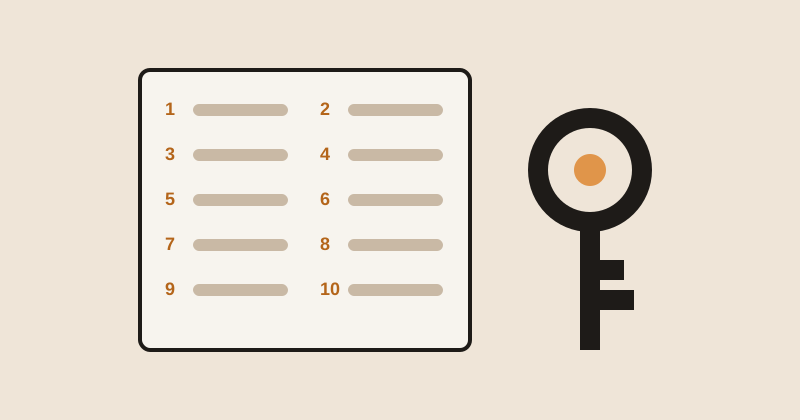
When you set up a modern crypto wallet, it shows you a list of twelve or twenty-four ordinary English words and asks you to write them down. Those words, usually called a seed phrase or recovery phrase, are the most valuable thing you will ever own in crypto. Anyone who has them can take your funds. If you lose them and your device fails, nobody can help you get the funds back.
Where the words come from
A wallet starts by generating a large random number. Good randomness is essential, which is why wallets rely on the device's secure sources of entropy. That number is then encoded as words from a fixed list of 2,048 entries. The words are simply a human-friendly way of writing down a very long number, with a checksum built in so that most typing errors are detected.
From that single seed, the wallet derives all your private keys and addresses in a predictable way. This is what makes recovery possible: enter the same words into any compatible wallet and it regenerates the same keys, the same addresses and therefore access to the same funds. Your coins live on the blockchain; the device only keeps a copy of the keys, and the words can always recreate them.
Why the phrase is more important than the device
Losing a phone or a hardware wallet is an inconvenience if you still have the phrase. You buy a new device, restore from the words, and carry on. Losing the phrase while the device still works is a warning sign: you should move the funds to a new wallet with a new phrase that you store properly. Losing both means the funds are gone permanently.
The opposite risk is just as serious. A phrase that someone else sees, photographs or copies gives them full control, without needing your device or your password. That is why almost every crypto theft involving individuals comes down, one way or another, to a leaked phrase or key.
How to store it
Write the phrase down by hand, on paper or on a metal plate designed for the purpose, which survives fire and water much better than paper. Check every word against the screen and keep the order exactly as shown. Store it somewhere private and secure, away from where you keep the device itself.
Never store the phrase digitally. That rules out photos, screenshots, notes apps, password managers synced to the cloud, emails to yourself and documents on your computer. Digital copies can be read by malware, by anyone who accesses your accounts, and by services that back up your files automatically.
Never type the phrase into a website or share it with anyone claiming to be support staff. No legitimate wallet, exchange or service will ever ask for it. A request for your recovery phrase is, with near certainty, an attempt to steal from you, a pattern described in our guide to how crypto scams work.
Backups and inheritance
One copy can be lost in a flood or a move. Many people keep two copies in different secure places. The trade-off is that every additional copy is another place where the phrase could be found, so each location must be genuinely safe.
More advanced approaches exist for larger amounts. Some wallets support an extra passphrase that is added to the seed, so that the words alone are not enough. Others split a secret into several parts using schemes such as Shamir's secret sharing, where a minimum number of parts is needed to recover it. Multi-signature setups require several separate keys to approve a transaction. These tools add protection and also add complexity, and a recovery plan that nobody understands can fail exactly when it is needed.
Inheritance deserves a thought too. If something happened to you, could the people you trust recover your funds, and would they know where to start? A sealed letter explaining where the phrase is kept, stored with your other important documents, is a simple step that many holders overlook.
A short routine
Write the words down carefully, store them offline in a safe place, test the backup by restoring a wallet with a small amount before relying on it, and never share the phrase with anyone. These habits take an hour to set up and protect you from the most common ways people lose crypto. For the wider picture, see our guide to self-custody.