Tokenization · 3 min read
The Long Tail of Tokenization: Royalties, Music Catalogues and Books
Tokenization is usually discussed in terms of bonds and buildings. Smaller assets such as royalty streams may be where the technology changes the most.
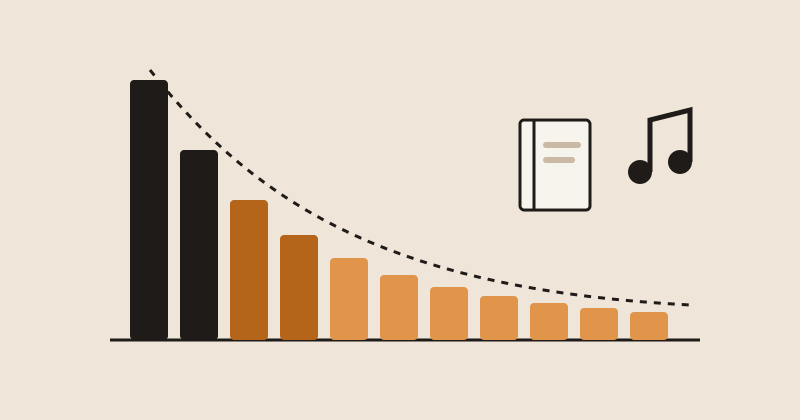
Most coverage of tokenized real-world assets (RWA) focuses on the largest categories: government bonds, money market funds, commercial property. Those are the markets where big institutions are experimenting, and where the amounts are easiest to headline. But there is a strong argument that tokenization matters most at the other end of the scale, for assets that were too small, too fragmented or too awkward to be shared under traditional structures.
Royalties are a good example.
What a royalty stream is
A royalty is a payment made to the owner of a right each time that right is used. A songwriter earns royalties when their song is streamed or played on the radio. An author earns royalties when a copy of their book is sold. A patent holder earns royalties when a manufacturer uses the invention under licence.
From a financial point of view, a royalty stream is a series of future payments whose size depends on how popular the underlying work remains. A classic song can earn steadily for decades. A niche book may sell modestly but consistently for years. Each stream is small on its own, and each one has its own contracts, reporting schedules and payment systems.
Why these assets were hard to share
Buying a share of a royalty stream has always been possible in principle. In practice, it was mostly limited to specialised funds and professional buyers. The paperwork, legal review and administration needed to split a stream among many people cost more than the stream was worth, unless the catalogue was very large. Music publishing catalogues have changed hands for large sums between companies, while the long tail of smaller works stayed out of reach.
The economics of administration are what kept the long tail closed. Every additional participant meant another contract to sign, another payment to calculate and another statement to send.
What tokenization changes
Tokenization attacks exactly that administrative cost. Once the legal agreement defining the rights is in place, a token can record who is entitled to what, in any proportion, at almost no extra cost per participant. Distributions can be calculated by a program and sent to every holder at once, often in a stablecoin, which avoids international bank fees and delays. We explain how that works in stablecoins as payment rails.
The public ledger also improves transparency. Holders can see how the tokens are distributed and verify that payments were made. Some structures publish the underlying sales or streaming reports alongside the on-chain distributions, so that anyone can match the income to the payouts.
Bundling is another useful technique. A single book or song is a concentrated bet on one work. A collection of many works, held together and represented by one token, spreads that dependence across a catalogue, which is how professional rights holders have always thought about their portfolios.
The rights come from the contract
As with every tokenized asset, the token is only the record. The right to receive royalty income comes from the legal agreement between the rights holder and the structure that issues the tokens. That agreement determines what share of income is passed on, how it is calculated, how often it is paid and what happens if the arrangement ends.
Anyone looking at a tokenized royalty product should read that agreement with care. The questions are concrete: which works are included, which income sources count (sales, streaming, licensing), what deductions apply before distribution, and how the sales data is reported and checked.
Realistic expectations
Royalty streams have attractive features. Their income often has little to do with financial markets, since people keep reading books and listening to music whatever happens to interest rates. They can also be long-lived. But they decline as well as grow, popularity is hard to predict, and the income from a single work can fade quickly.
Tokenization leaves those fundamentals in place. Its contribution lies elsewhere: it widens who can take part, lowers the cost of sharing the income, and makes more of the process visible. For an asset class that spent a century locked behind paperwork, that is a significant shift, and the long tail of tokenization may prove more interesting than the headline deals.