Privacy · 4 min read
Zero-Knowledge Proofs Explained Without the Math
How you can prove something is true without revealing why it is true, and why this idea now sits at the centre of blockchain privacy and scaling.
Imagine proving to a bouncer that you are over eighteen without showing your date of birth, your name or your address. Or proving to a lender that your income is above a certain level without handing over your payslips. That is the promise of a zero-knowledge proof: a way to convince someone that a statement is true while revealing nothing beyond the fact that it is true.
The idea comes from academic cryptography in the 1980s. For decades it was mostly a theoretical curiosity. Today it is one of the most important tools in blockchain design, used both to protect privacy and to make networks faster and cheaper.
The cave and the magic door
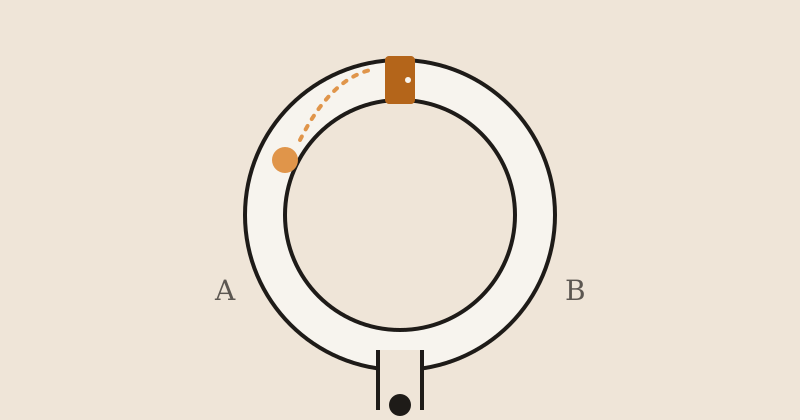
The classic way to explain the concept involves a circular cave with a single entrance and a locked door at the back connecting the two sides of the loop. Peggy claims she knows the secret word that opens the door. Victor wants to be convinced, but Peggy does not want to tell him the word.
So they play a game. Victor waits outside while Peggy walks into the cave and takes either the left or the right path. Victor then comes to the entrance and shouts which side he wants her to come out from. If Peggy knows the word, she can always comply, opening the door if she needs to. If she does not, she has only a one-in-two chance of having picked the right side to begin with.
One round proves little. But after twenty rounds, the chance that Peggy has been guessing correctly every time is about one in a million. Victor becomes convinced that she knows the word, and yet he has learned nothing about the word itself. He could not even convince a third person, because a recording of the game could have been staged.
The three properties
Cryptographers describe a zero-knowledge proof using three properties. It must be complete: if the statement is true, an honest prover can always convince the verifier. It must be sound: if the statement is false, a cheating prover cannot convince the verifier except with a negligible probability. And it must be zero-knowledge: the verifier learns nothing except that the statement is true.
The cave story has all three, but it needs back-and-forth interaction. Modern systems used on blockchains are non-interactive. The prover produces a single compact proof that anyone can check later, without further conversation. A widely used family of these is known as zk-SNARKs, short for zero-knowledge succinct non-interactive arguments of knowledge. The word "succinct" matters: the proofs are small and quick to verify, even when the statement behind them is complicated.
Use one: private transactions
On a public blockchain, the network normally checks a transaction by looking at it: who is sending, who is receiving, and whether the sender has enough funds. With zero-knowledge proofs, the sender can instead submit a proof that says, in effect, "this transaction follows all the rules, the inputs exist, they have not been spent before, and the amounts balance", without revealing the addresses or the amounts.
The network verifies the proof and accepts the transaction. The ledger stays correct, and nobody watching it learns the details. Several cryptocurrencies use this approach to offer optional or default privacy, and the same technique can be applied to tokens on general-purpose blockchains.
Use two: scaling
The second major use has nothing to do with privacy. Blockchains are slow and expensive partly because every participant re-checks every transaction. A zero-knowledge proof can compress that work: a separate system processes thousands of transactions, then publishes one short proof that all of them were valid. The main chain only needs to verify the proof.
These systems, often called ZK rollups, are a large part of how networks like Ethereum aim to grow. The ethereum.org overview of zero-knowledge proofs describes both the privacy and the scaling applications in more depth.
Use three: proving facts about yourself
Perhaps the most interesting long-term use is identity. A trusted authority could issue you a digital credential, and you could then prove specific facts from it, such as being over a certain age, being resident in a given country or having passed a compliance check, without handing over the credential itself.
For crypto and tokenized assets, this could ease one of the hardest tensions in the field. Regulated services need to know that their customers meet certain requirements. Customers would rather not scatter copies of their passport across dozens of platforms. A proof that says "this person has been verified" without revealing who they are would satisfy both sides.
The limits
Zero-knowledge proofs are powerful, but they are not free. Generating a proof can require significant computing power. Some systems depend on an initial setup ceremony, and if that setup is compromised the guarantees weaken. The software is complex, and bugs in complex cryptographic code can be severe.
Most importantly, a proof only covers what it is designed to prove. A transaction can be fully shielded on-chain and still leak information through timing, through the exchange you used, or through the way your wallet connects to the network, as we explain in what privacy really means on a public blockchain. Zero-knowledge proofs are an excellent lock. Privacy still depends on the rest of the house.